
Estimated reading time: 13 minutes
General information only: This guide is designed to help you understand the divorce process in Australia and prepare for next steps. It is not legal advice. Every family’s circumstances are different—if you’d like advice tailored to your situation, speak with a family lawyer or our family lawyers for personalised guidance.
Quick answer
To apply for a divorce in Australia and initiate divorce proceedings, you generally must be separated for at least 12 months and 1 day . You then file an Application for Divorce (usually online) through the Federal Circuit and Family Court of Australia; this is the standard divorce application process for filing for divorce. A divorce typically takes a few months from filing to finalisation, depending on service requirements and the Court’s scheduling, and may include a divorce hearing if required.
Divorce Legally Ends The Marriage
Divorce legally ends the marriage, but property settlement , parenting arrangements , and child support are separate processes that usually need to be addressed prior to, alongside (or soon after) divorce under Australian family law.
What to do first (before you file anything)
If you want the quickest, least expensive path to apply for a divorce—with the best chance of a stable outcome if it proceeds to a divorce hearing—start here (see the divorce application checklist below):
- Confirm your separation date (write it down). Divorce requires a minimum separation period.
- Stabilise parenting arrangements (if you have children). Even a basic written plan helps reduce conflict.
- Start documenting assets and debts (property, superannuation, loans, businesses, vehicles, credit cards).
- Consider safety first if there is family violence or coercive control—get support and urgent legal advice.
- Get legal guidance early if there are children under 18, overseas issues, significant assets, business interests, or “separation under one roof”.
Need help now? If you’d like to understand your best pathway (negotiation, mediation, consent orders, or Court), you can speak with our Family Law Team—experienced family lawyers who can guide your application for divorce.
Contact Awkar & C for assistance now
Divorce vs separation vs property settlement (what people confuse)

Separation is when your relationship ends. It can happen even if you still live in the same home.
Divorce is the legal process that ends a marriage. It does not automatically finalise parenting or financial issues.
Property settlement is the legal division of assets, liabilities, and superannuation—this can be negotiated and formalised by consent orders (or litigated).
Parenting arrangements cover the children’s living arrangements, time with each parent, and decision-making.
Child support is usually managed through Services Australia (and/or private agreements in some cases).
Strategically, many people get better outcomes when they treat divorce as one piece of a bigger plan, rather than “the whole process”.
Helpful links: Separation | Divorce | Property Settlement | All Family Law Services
Step-by-step: How divorce works in South Australia
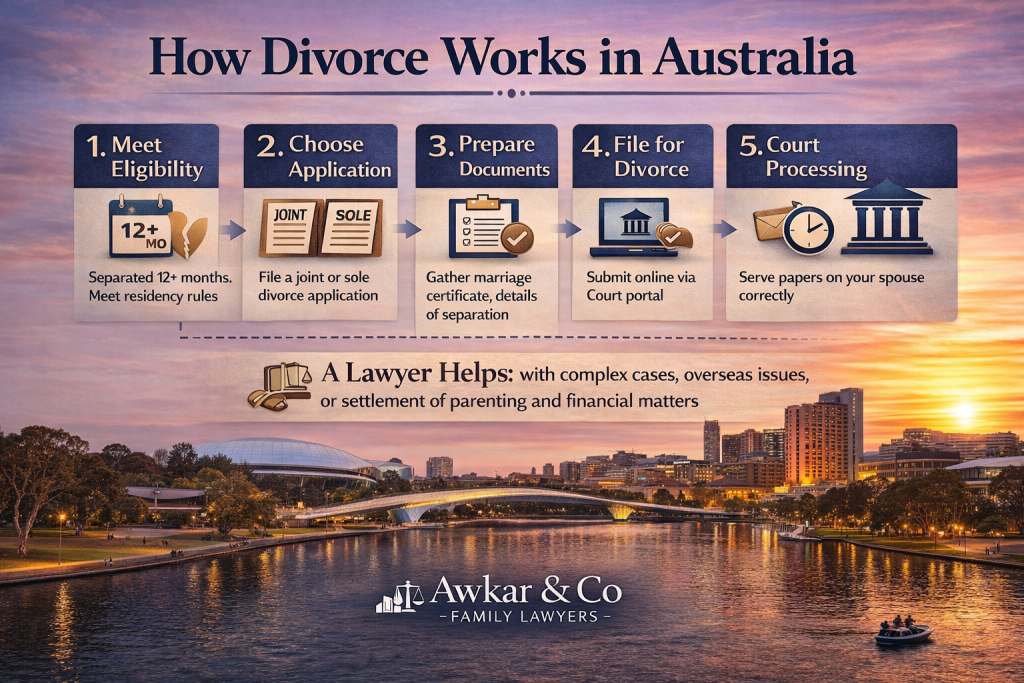
Step 1: Make sure you’re eligible to apply
In most cases you need to show:
- You and your spouse have been separated for at least 12 months and 1 day.
- There is no reasonable likelihood of resuming married life.
- You or your spouse meets the Court’s requirements for applying in Australia (for example, citizenship or residency).
Separated under one roof? If you lived together during separation, you may still be eligible, but you’ll usually need additional evidence to show you were separated in practice (e.g., finances, household arrangements, social presentation).
Step 2: Decide between a joint application or sole application
- Joint application: you apply together. Often simpler because there is no requirement for one party to formally serve documents on the other.
- Sole application: one party applies. You must usually serve the application on the other party correctly and on time (service rules matter).
Quick-win tip: If it’s safe and feasible, a joint application often reduces delays and procedural issues.
Step 3: Prepare your documents (properly)
Common requirements include:
- Marriage certificate (and translation if not in English)
- Details of separation date and arrangements
- Information about any children under 18
- Service documents if you are filing a sole application
Step 4: File the Application for Divorce
Most divorce applications are filed online via the Commonwealth Courts Portal / Federal Circuit and Family Court of Australia system.
Step 5: Service (sole applications)
If you apply on your own, you must serve the documents according to the Court rules. This is one of the most common causes of delay, rejection, or adjournment—especially where the other party is uncooperative, overseas, or difficult to locate.
Step 6: Hearing (if required) and the divorce order
Some divorces require a hearing; others can be handled without a personal appearance. If the Court is satisfied with the application, it will grant a divorce order.
Step 7: When the divorce becomes final
In Australia, the divorce order does not become final immediately. There is typically a waiting period after the order is made before it becomes final, and then a divorce certificate is available.
Divorce timeline (typical) — from separation to final divorce
| Stage | What happens | Typical timeframe | What can slow it down |
|---|---|---|---|
| Separation begins | You separate (can be under one roof) | Day 1 | Unclear separation date; under-one-roof evidence issues |
| Minimum separation period | You must be separated for a minimum period before filing | 12 months + 1 day | Disputes about separation date; reconciliation attempts |
| Prepare and file application | Submit Application for Divorce online | 1–2 weeks (typical) | Missing documents; incorrect details; translation issues |
| Service (sole applications) | Serve the other party correctly and on time | 2–6+ weeks | Can’t locate spouse; overseas service; defective service |
| Court processing & hearing (if needed) | Court reviews the application and lists it if required | 6–12+ weeks | Court availability; service disputes; extra evidence needed |
| Divorce order made | Court grants the divorce order | On hearing/review date | Adjournment due to service or evidence problems |
| Divorce becomes final | Waiting period passes and divorce is finalised | Usually 1 month + 1 day after the order | Appeal issues (rare); procedural complications |
Quick-win tip: If you want speed, focus on “no preventable delays”: clean documents, correct service (if sole), and clear evidence if separated under one roof.
How much does It Cost to Apply for a divorce in South Australia?
1) Court filing fee (the baseline cost)
To apply for divorce, you pay a Court filing fee. A reduced fee may apply in some circumstances (for example, if you hold certain concession cards or can show financial hardship).
2) Service costs (sole applications)
If you file a sole application, you may have costs associated with service (e.g., process server or other approved methods), especially if the other party is hard to locate or overseas.
3) Legal costs (optional but often cost-saving overall)
You don’t “have” to use a lawyer to file for divorce. But legal support can be cost-effective when it prevents mistakes, avoids adjournments, and helps you coordinate divorce with parenting and property outcomes. Our family lawyers can guide strategy and paperwork from start to finish.
Commercial reality: The biggest “cost blowouts” usually don’t come from the divorce application itself—they come from unresolved disputes about parenting, property, or poor preparation that escalates conflict.
What happens if we have children under 18?
If you have children under 18, the Court needs to be satisfied that proper arrangements have been made for their care, welfare, and development. Divorce does not decide parenting orders—but the application asks questions about the children, and you should be prepared to explain the practical arrangements.
If parenting arrangements are uncertain, disputed, or unsafe, you may need advice about:
- Parenting plans vs consent orders
- Dispute resolution / mediation pathways
- Urgent Court applications (in serious cases)
Related: Parenting & Children | Mediation | Contact
Property settlement and divorce: the trap most people fall into
A common misconception is that divorce automatically divides assets. It doesn’t.
Property settlement usually requires negotiation and then formalisation (for example, consent orders) or litigation if agreement can’t be reached. Importantly, there are time limits that can apply to property settlement and spousal maintenance after divorce finalisation—so it’s a smart idea to get advice early especially concerning property and parenting matters, even if you’re not ready to “finalise everything” immediately. In some cases financial disputes are often resolved through property settlement mediation
Related: Property Settlement | Spousal Maintenance
Divorce preparation checklist (print this)
Your divorce application checklist to stay organised.
A) Before You Apply for A Divorce
- Confirm your separation date (and note any reconciliation periods)
- If separated under one roof, document:
- separate bedrooms / household arrangements
- separate finances / bank accounts
- public/social separation (friends/family aware)
- Collect your marriage certificate (and translation if needed)
- List children’s current arrangements (school, time with each parent, routines)
- Safety check: if there is family violence, get support and advice urgently
B) Financial preparation (even if you’re not “doing property settlement yet”)
- Create a simple asset & debt inventory:
- real estate
- superannuation
- vehicles
- business interests
- bank accounts
- shares/crypto/investments
- credit cards and loans
- Download recent statements (12–24 months where possible)
- Consider what documents would evidence contributions (financial and non-financial)
C) If you’re filing a sole application for divorce
- Confirm the other party’s current address and contact details
- Plan service early (service errors are a top cause of delay)
- Keep records of service attempts and communications
D) Your “best outcome” plan
- Decide your preferred pathway: negotiated agreement, mediation, or Court
- Identify your non-negotiables (children’s safety/stability, key assets, housing)
- Book early advice if there are complexities (children under 18, overseas issues, business assets, major disputes)
When should you speak with a divorce lawyer?
You should consider legal advice early if any of these apply:
- Children under 18 and parenting is disputed or unstable
- Family violence, coercive control, or safety risks
- “Separation under one roof” and you need help preparing evidence
- Property complexity: business, trusts, self-employed income, high assets, hidden asset concerns
- Overseas spouse or international relocation concerns
- You want to formalise property/parenting efficiently and avoid Court
Local note: Awkar & Co assists clients across Adelaide and South Australia, including Norwood and surrounding suburbs. If you’re in SA, your application for divorce SA follows the same national online process via the Commonwealth Courts Portal.
Book a confidential consultation
FAQs: Divorce in South Australia
How long do you have to be separated before divorce in South Australia?
In most cases, you must be separated for at least 12 months and 1 day before you can apply for divorce.
Can we be separated and still live in the same house?
Yes. This is often called “separation under one roof”. You may still be eligible to apply for divorce, but you may need additional evidence to show you were separated in practice.
Do I need a divorce lawyer to get divorced in South Australia?
No. Many people file for divorce without a lawyer. However, legal advice can help prevent delays and ensure divorce is coordinated properly with parenting and property settlement decisions.
Does getting divorced automatically divide our property?
No. Divorce ends the marriage, but property settlement is a separate process that usually requires agreement and formalisation (or Court orders if you can’t agree). In most cases property settlement negotiations commence before you file an application for divorce as there are time limits after a divorce is finalised.
Can we finalise parenting arrangements without going to Court?
In many cases, yes—through negotiation, mediation, parenting plans, and/or consent orders. The best pathway depends on safety, communication, and the complexity of the issues.
What if my spouse won’t cooperate?
You can usually still apply for divorce with a sole application, but you must follow service rules. If cooperation is unlikely, planning service early can prevent unnecessary delays.
Next steps
If you want the fastest, cleanest resolution, the right approach is usually:
- Confirm eligibility and separation date
- Stabilise parenting arrangements (where relevant)
- Start property documentation early
- Choose the best pathway: negotiation, mediation, or Court
We can help you understand your options, avoid avoidable delays, and build a clear plan from separation through to divorce, parenting, and property outcomes.
Divorce | Separation | Property Settlement | Contact Awkar & Co
Further Q&A – Divorce in South Australia
Question: What evidence helps if we were “separated under one roof”?
Short answer: You’ll usually need to show you were separated in practice, not just in name. Helpful evidence includes:
- Separate bedrooms/household routines
- Separate finances/bank accounts and no joint financial management
- Public/social separation (friends/family knew the relationship ended)
- A clear, recorded separation date (note any brief reconciliations) This aligns with the Court’s requirement to be satisfied you were genuinely separated for at least 12 months and 1 day.
Question: Should we file a joint or a sole Application for Divorce?
Short answer: If it’s safe and feasible, a joint application is often simpler and faster because there’s no need to “serve” documents on the other spouse. A sole application is fine too, but you must correctly serve the papers and on time—service errors, uncooperative spouses, or overseas service are common causes of delay or adjournment. Plan service early if filing alone.
Question: How long does a divorce take from filing to finalisation?
Short answer: It typically takes a few months, but timing depends on service and Court scheduling.
As a guide:
- Prepare and file: about 1–2 weeks (if documents are ready)
- Service (sole applications): about 2–6+ weeks (longer if the spouse is hard to locate/overseas)
- Court processing/hearing (if required): about 6–12+ weeks
- Finalisation: usually 1 month + 1 day after the divorce order is made Clean documents, correct service, and clear “under one roof” evidence help avoid preventable delays.
Question: Do we need to finalise property and parenting before getting divorced?
Short answer: No—divorce only ends the marriage. Property settlement and parenting arrangements are separate processes. Strategically, many people address parenting stability and start property documentation early (often negotiating property settlement before or alongside divorce). Be aware there are time limits that can apply to property settlement and spousal maintenance after divorce, so early advice is sensible.
Question: How much does it cost to apply for divorce, and can fees be reduced?
Short answer: Legal costs (optional): A lawyer isn’t required, but targeted advice can prevent errors, adjournments, and future disputes. In practice, the biggest cost blowouts usually stem from unresolved parenting/property issues or poor preparation—not the divorce application itself.
Court filing fee: payable when you file; a reduced fee may apply if you hold certain concession cards or can show financial hardship.
Service costs (sole applications): you may need to pay for a process server or other approved service methods, especially if your spouse is hard to locate or overseas.
Divorce | Separation | Property Settlement | Contact Awkar & Co